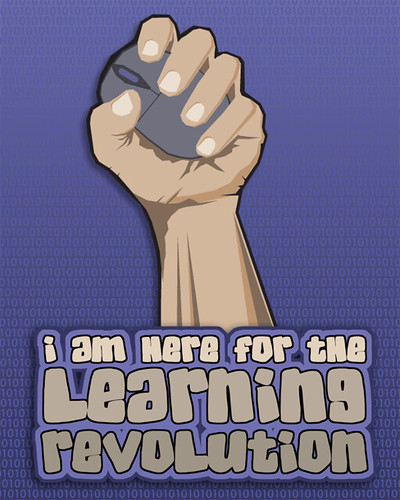
I’ve been having some revolutionary thoughts lately.
And these are beyond the ordinary musings of a screenwriter, such as, “I’d love to see a nuclear explosion wipe out these ego-maniacal fucks in Hollywood.”
No, my thoughts have centered more around my long-promised, free, screenwriting book that I’ve been working on, which has been tentatively titled, The Screenwriting Revolution. I don’t know when it’ll be available except to say – when it’s damn good & ready.
How can this next generation distinguish themselves?
Let us speak now about the litany of crappy 2009 films. You can blame it on the writer’s strike all you like. The fact is, the craft of screenwriting has been in decline for years, and I can’t help but wonder if it’s time for a revolution, time for the next generation of screenwriters to step up and make their voices heard. And take storytelling into exciting and interesting new directions.
But how can this next generation distinguish themselves?
Let me list a few random thoughts and then I’d like to hear what YOU think would be appropriate for a screenwriting revolution.
Format & Grammar
First and foremost, a writer ought to know how to write and a screenplay ought to look like a damn screenplay. Some might think that sounds so reasonable as to be anything but revolutionary, but this, of all things, continues to be one of my most controversial positions. People love to point out that most screenplays are generally filled with poor writing and poor format and thus, they should be able to write like a child, too. This is one of the great rationalizations for declining standards in films.
First and foremost, a writer ought to know how write and a screenplay ought to look like a damn screenplay.
You need to embrace learning and knowledge and the joy of using your brain and writing brilliantly. The fact is, quality screenwriting begins here. If everyone else is writing like shit, that’s even more of a reason for you to write gold, because it’ll make you stand out. At the end of the day, it’s not about what everyone else is doing. It’s about what YOU are doing and how your work reflects upon YOU.
If you don’t like what I’m saying – great. I’m going to write circles around you.
Reject the Gurus
On the one hand, I believe that you should be a brilliant, well-read writer who has digested many, many guru books so that you will know what many people around the world think about screenwriting. (Although I would suggest getting those books from the library, if possible. I wouldn’t give those people a dime of my money.) Then you should study films (and stories) for yourself. You will probably realize that, more often than not, the art of storytelling is never black-and-white but endlessly grey and that gurus are generally limited in their imaginations, which is why they’re not writing stories.
You should be a brilliant, well-read writer who has digested many, many guru books.
Truth be told, I’m at my wit’s end with Robert McKee whose idea of a seminar is bullying people like a thug into accepting his limited ideas about storytelling. That he even acts like a pompous ass should be the first red flag to observers because it means he’s intellectually stifled (and thus, must resort to bullying) particularly when he’s challenged with solid exceptions to his narrow-minded “principles.” HE just wants stories to be told the way HE likes them to be told.
Let’s count three little ways he’s wrong:
– McKee wrote in his book, Story, (pg 104): “The finest writing not only reveals true character but arcs or changes [to] that inner nature for better or worse, over the course of the telling.” What a rank steaming pile of horseshit. How about one of the most iconic figures of the spy genre, and with a few exceptions, such as On Her Majesty’s Secret Service and Casino Royale, James Bond RARELY had an arc. That is a fact. This isn’t debatable. We don’t want him to change. We love him just the way he is. He gets the job done and he does it with style. Can you imagine how different he’d be today if he had a change to his inner nature in every single film? He’d be a villain now, would he not? Bond proves the point that when it comes to franchises, arcs are not a requirement for satisfaction or longevity. I loved the point Ebert made in his Quantum of Solace review about Bond’s best quality. Bond is not some dumb action hero. He is a figure who rises above all of the baddies of the world and rarely lets them get him down. “This is a swampy old world,” Ebert wrote. “The deeper we sink in, the more we need James Bond to stand above it.” Exactly. THAT is the bigger point to his character and why we love to spend time with him again and again and again. Is there anything wrong with that? Hell no.
– Not just McKee but most gurus teach you that every protagonist in every story MUST be sympathetic. Then please explain to me the universal appeal of Ebenezer Scrooge. There is joy to be had in watching the transformation of a totally unsympathetic protagonist, is there not? The Lives of Others was a fantastic film about the transformation of a monstrous Hauptmann Gerd Weisler. How about satire? The whole point of satire is to ridicule the protagonist who has to be unsympathetic. Most recently, I watched In the Loop, which had me rolling in laughter. I don’t think there was a sympathetic character anywhere in that film. But, you see, that’s the point because it’s SATIRE. In the end, almost all of those unsympathetic characters got their comeuppance, which is quite satisfying.
– Who is the most complex character in the history of literature? Hamlet. And in McKee’s Story, he praises the complexities of the prince (page 378): “Hamlet isn’t three-dimensional, but ten, twelve, virtually uncountably dimensional. He seems spiritual until he’s blasphemous. To Ophelia he’s first loving and tender, then callous, even sadistic. He’s courageous, then cowardly. At times he’s cool and cautious, then impulsive and rash, as he stabs someone hiding behind a curtain without knowing who’s there. Hamlet is ruthless and compassionate, proud and self-satisfying, witty and sad, weary and dynamic, lucid and confused, sane and mad. His is an innocent worldliness, a worldly innocence, a living contradiction of almost any human qualities we could imagine.” Does that sound like a sympathetic protagonist to you? No.
What was Hamlet’s overriding quality? He was passive.
He is a character with depth, which is far more intriguing and valuable to the art of storytelling than flat sympathy. Hamlet was so brilliant that he is the only character in all of Shakespeare’s canon who could have written his own play. But what was Hamlet’s overriding quality? He was passive. He was caught inside a revenge story and yet because he was so brilliant, he was free from it. He could see all sides of everything and pontificated as much. He could exact revenge – or not. It didn’t matter, because he saw everything. He was, as Harold Bloom wrote, “a reflecting pool, a spacious mirror in which we needs must see ourselves.” It was through his passive nature that the genius of Shakespeare and his life-altering poetry shined through in ways never seen before.
So what say you? Shall we dumb down the art of storytelling to simplistic formulas or shall we find inspiration in the greatest characters ever created and shoot for the moon?
To Hell with Structure
Let me say, first of all, that every aspiring writer should be experts on structure, especially the 3-act form. You should know the 3-act backwards and forwards, and I don’t mean being book smart about it, either. I don’t care how easily you can rattle off to anyone anywhere how the structure works. I’m talking about the knowledge that comes from the experience of writing many, many scripts within the 3-act structure. You need enough writing experience in your life of shaping stories to fit the 3-act structure, of building tension, of molding that rising climax, and creating satisfying payoffs so that you can feel the 3-act structure in your bones as you compose a story. That never happens overnight.
The 3-act structure is nothing less than a cheap security blanket for the most insecure industry in the world.
But once you accomplish that, you should say, “To hell with structure.”
Truth be told, the 3-act structure is nothing less than a cheap security blanket for the most insecure industry in the world. The people of Hollywood cannot free themselves from the absurd belief that the structures of previously successful 3-act films will guarantee success in future stories. While I certainly love Casablanca, I would never tell anyone that this one script should be the model for all screenplays. How fucking ridiculous is that? Who wants to see a thousand variations of Casablanca? Each genre has its own unique set of rules and clichés. What works in one story in one genre does not necessarily work in another story in another genre. Not every compelling story can be so easily shoehorned into the sometimes simplistic and formulaic 3-act structure. There is so much joy to be had from so many other structures, such as The Godfather, which was a 4-act structure like many Italian operas.

Alfred Hitchcock was notorious for breaking structure. Many of us think back on the Psycho shower scene as being shocking by the fact that there was this surprising, scary, brutal murder that took place in the shower. However, we forget that so much of the shock in that moment sprung from the fact that Hitchcock was killing off his protagonist. We were following this woman and getting involved in the drama of her life and then – eek-eek-eek! – she’s dead. Gone. Hitch totally pulled the rug out from underneath us and we were suddenly lost, narratively speaking, by her death. Who do we follow now? Where does the story go? We’re all alone in this motel with this crazy killer! Has there ever been a guru suggesting that great horror films should follow Hitch’s model of Psycho by killing off the protagonist halfway into the film? Who says you can’t kill off your protagonist? A good long study of Hitchcock reveals many, many interesting (and successful!) breaks in structure.
Question: do you honestly think that by following formula and doing what everyone else is already doing is going to get you noticed? Consider how Memento put Christopher Nolan on the map or how Pulp Fiction made Quentin Tarantino famous or how Rashomon shined a light of well deserved international acclaim onto Akira Kurosawa, one of my favorite directors. Most recently, we had the non-linear narrative approach of (500) Days of Summer written by first-time screenwriters Scott Neustadter and Michael Weber. I recall Kelly Masterson’s debut screenplay, Before the Devil Knows You’re Dead, was a break in structure that impressed Sidney Lumet enough to turn into a film. An argument could be made that new writers with structurally ground-breaking work move to the front of the line.
But have solid reasons for doing what you’re doing and never lose sight of the fact that your characters always come first. You find success by how the break in structure serves your characters.
Final Thoughts
So how can we start a revolution? Hmm. I’ll toss up three ideas:
- By rejecting the simplistic formulas and structures outlined by the gurus.
- By embracing experimentation.
- By supporting each other as a community.
What say you, readers?
– Mystery Man

I’m famous yet anonymous, failed yet accomplished, brilliant yet semi-brilliant. I’m a homebody who jetsets around the world. I’m brash and daring yet chilled with a twist.
I also write for Script Magazine.
_________________________
photo credits:
- another_finn (gun)
- tj scenes (che)
- Wesley Fryer (mouse revolution)
engineroomblog (anarky)