

I have worked in the film and television industry for thirty-five years now. And I find there is one really easy way to tell whether someone understands their own story or not.
Can they write a logline for it?
I am not saying that writing a logline gives you the ability to write great scripts, but using your logline a professional will be able to assess whether your concept rocks – or sucks.
[button type=”transparent” shape=”rounded” size=”large” href=”https://checklist.loglineit.com” title=”Get The Logline Checklist” window=”yes”][icon type=”check”]Get The Logline Checklist![/button]
A good logline is the DNA of the story.
It’s a tired metaphor, but it works. If you have a strong concept, the logline already contains – or implies – all the critical ingredients of the story; its DNA if it were.
Looking for example loglines on the web, you’ll find any kind of short summaries: Theme statements, tag lines, paragraph summaries, short pitches, teasers etc. They each fulfill a function in their own way. But they certainly are not loglines.
When you hear a logline of a movie you have seen, there is absolutely no doubt about which film it is. Using a few key elements of the story, the logline triangulates the exact film you are referring to. Try it!
Often, you can figure it out after only two of the mandatory three elements. Here’s one for you: “When an exiled dream thief is offered the chance to see his children again…”
No need to go any further. Either you know it, or you don’t. Everyone who has seen Inception will know that this is the movie I’m talking about.
Now, what are the occasions when you need a logline?
In my view, there are two instances when you really need a concise, one-sentence summary of your story.
When a logline can save you
You can probably think of a few more instances where loglines can save your behind. However, the screenwriter should have this little secret weapon at hand during these two stages of their work:
- when you are developing your story
- when you are marketing your story
For each, you may need a different type of logline.
You will have to rewrite your logline in accordance with the intended audience for it. For instance, when you pitch to a producer, you will need a different version from the one that will go on the cover of the BluRay disk.
Audiences can sometimes be teased using colourful details about aspects other than the story. Producers need to know as much as possible, in as little time as possible.
Your logline must cover the full story
Many flawed loglines only set up the inciting incident. They cover the ‘what if’ event that kicks off the story, but don’t promise us much for the second act, where the meat of the story should sit.
When you’re pitching to Hollywood, and the movie is an adventure, you don’t need to explain that there will be a happy ending. Mostly if the hero’s goal is clear, we will assume they achieve that goal.
However, where you have a twist, or a bittersweet ending, the producer needs to know.
 25 words can be a challenge
This is why you need to start building this skill. Right now.
For me, loglines don’t have to be limited to 25 words. Often, the 35-word version sounds much better. Still, you need to train yourself in concision. You may have to condense further, as most festivals or film market impose word count limitations.
It always depends on what the purpose of the logline is. If you only need to tease, of course you don’t give the full story.
However, until your film is made, those you pitch to will want to hear it all… despite what some experts say.
Should I use the logline during a pitch?
A top Hollywood screenwriting teacher advises not to use loglines during pitching. I disagree.
When I organised a pitching event a few years ago, the first thing the producer on the panel asked the writer:
“And what’s your logline?”
So there.
Over the years I have come to realise that the logline is more important than any other summary form of your story. It helps you understand your story, and it helps (others) assess whether it has a chance to work.
A simple, clear and powerful logline will help people to talk about your movie concept, and to create buzz. A long, confusing sentence will put people off. Your story won’t be mentioned.
The stronger your concept, the easier it will be to write that one-liner. The more your story is execution-dependent (a way for producers to say, they’re not interested), the more words you will need to set your story apart from the rest.
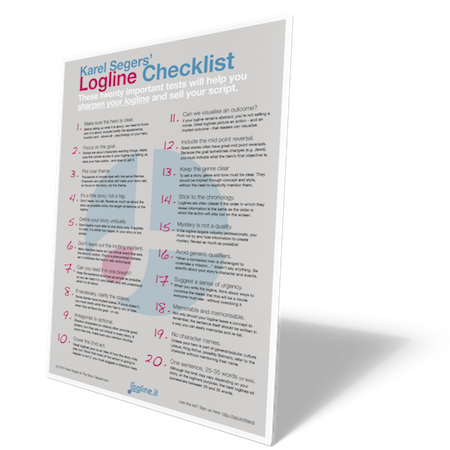
I have created a simple checklist that goes over some of the key elements of a great logline. Click on the button below to download your own copy now!
[button type=”transparent” shape=”rounded” size=”large” href=”https://checklist.loglineit.com” title=”Get The Logline Checklist” window=”yes”][icon type=”check”]Get The Logline Checklist![/button]
Yes, there is a formula. And it’s simple.
I use a formula that is super powerful, because it immediately tests whether your concept has the critical components that make up a screen story:
When [a major event happens], a(n) [flaw + main character] must ([overcome the flaw], and) [do/pursue the main action/goal].
The character journey is hinted at through the flaw, but you can emphasise it further if you wish.
For Jaws, this becomes:
When a swimmer is killed by a great white, a bureaucratic sheriff must take responsibility, protect the people, and kill the shark.
Obviously this formula sometimes results in a clunky first draft. Still, I insist that beginning screenwriters stick to it. First make sure your logline contains all the critical components, then start polishing.
In a future article, I will explain why to include just these story parts, and what other variations you might consider.
(And if you’re not too sure about the responsibility thing in Jaws, just read the bits on Jaws here and here.)
Logline It!
In your early career, you may benefit more from sharing your concepts than from being secretive about them. Get feedback, improve, iterate.
To help you with this process, visit https://loglineit.com, the world’s only website exclusively dedicated to helping writers create the best possible logline for their work.
Join up, it’s simple and fun. Read other people’s loglines, and post your own. Go back, refine your loglines (in the comments section) and see how fast your loglining skills will improve!
Now go and logline!
-Karel Segers